Generative AI tools are increasingly moving beyond static text responses towards richer, interface-driven explanations. In this post, we explore Gemini’s Dynamic View feature using a conceptually demanding technical question about transformer architectures. Rather than producing a conventional paragraph-style summary, Gemini generated an interactive, visually structured learning environment that allows users to explore the architecture step by step.
Prompt
Explain how transformer models work (based on Vaswani et al. 2017)
The task was formulated as a simple, concise instruction, without additional scaffolding, formatting requirements, or follow-up constraints. No structured output, step breakdown, or pedagogical guidance was requested in the prompt itself. The underlying academic reference (Vaswani et al., 2017) could optionally be attached as supporting material, but the Dynamic View functionality does not depend on extended prompt engineering.
Gemini’s Dynamic View can be accessed directly within the Gemini interface by selecting the corresponding visual/interactive output option when available for explanatory queries. When activated, the system automatically transforms a standard textual explanation into an interactive, component-based learning environment.
Output
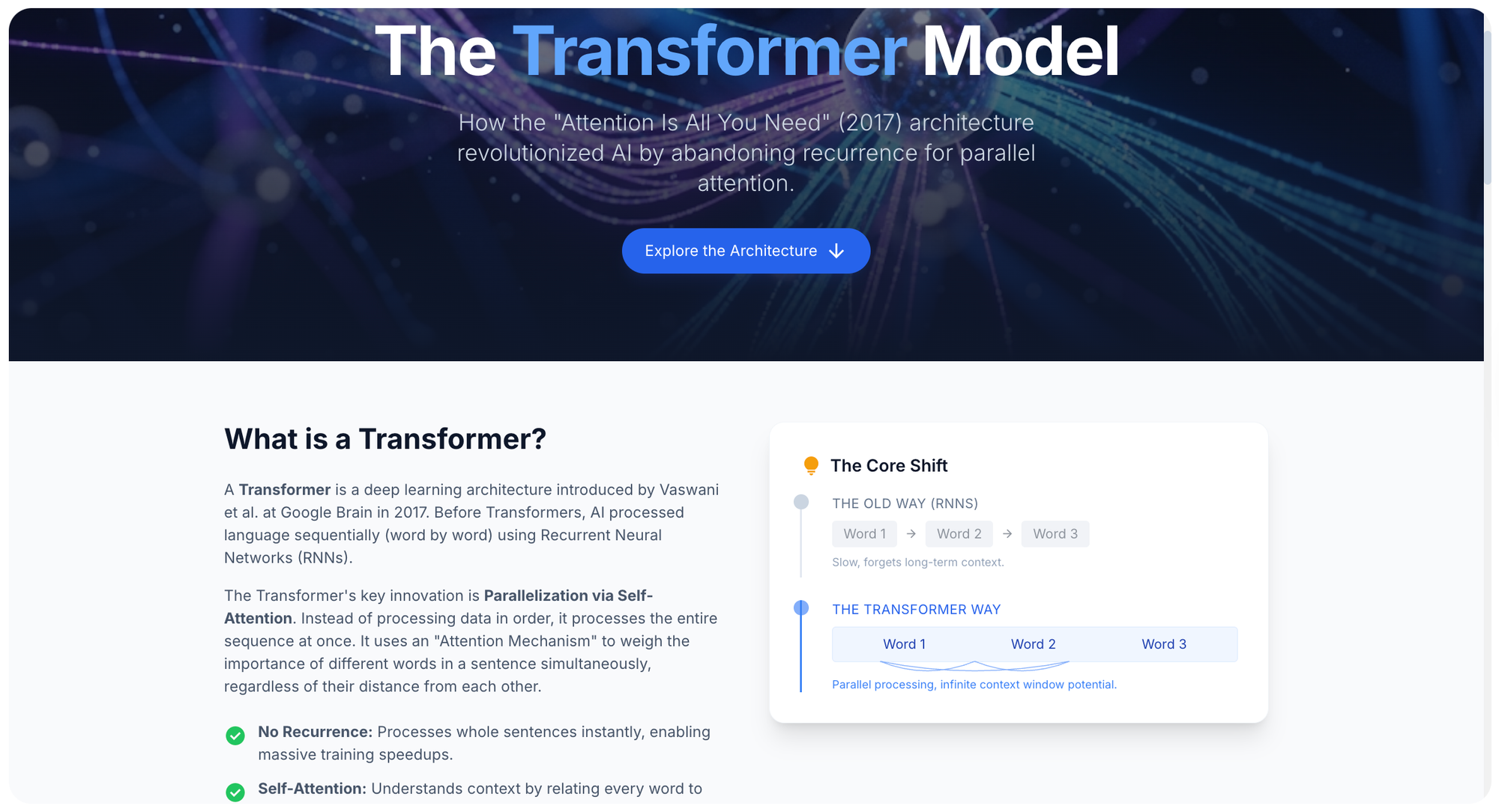
Gemini’s Dynamic View transformed the explanation of the transformer architecture into an interactive visual module rather than a static textual response.
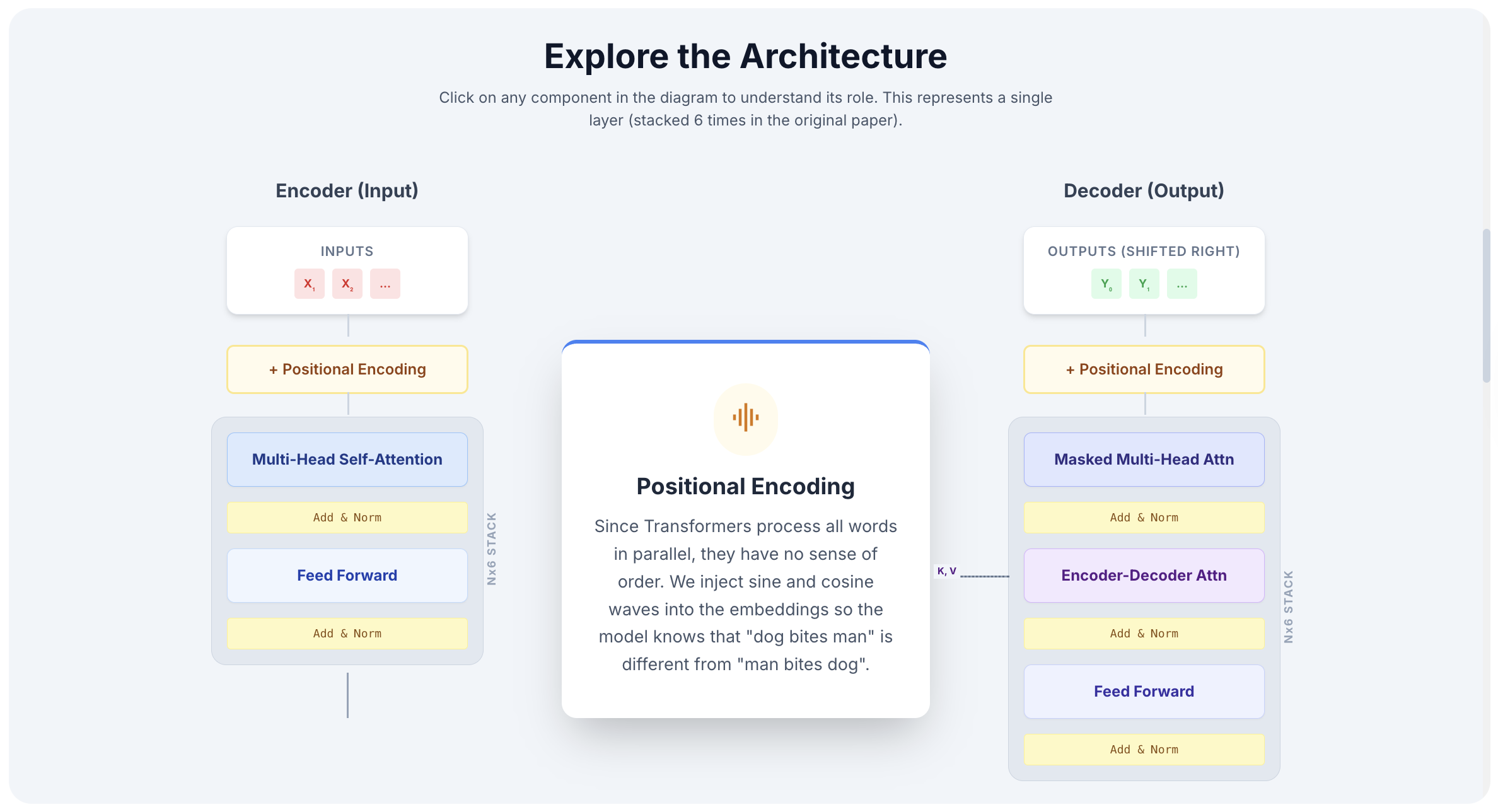
Instead of presenting a linear summary, the interface allows users to click on individual components—such as positional encoding, multi-head self-attention, and encoder–decoder interactions—to reveal simplified explanations and contextual highlights. This modular structure reduces cognitive load and supports incremental understanding of a concept that is typically dense and mathematically demanding.
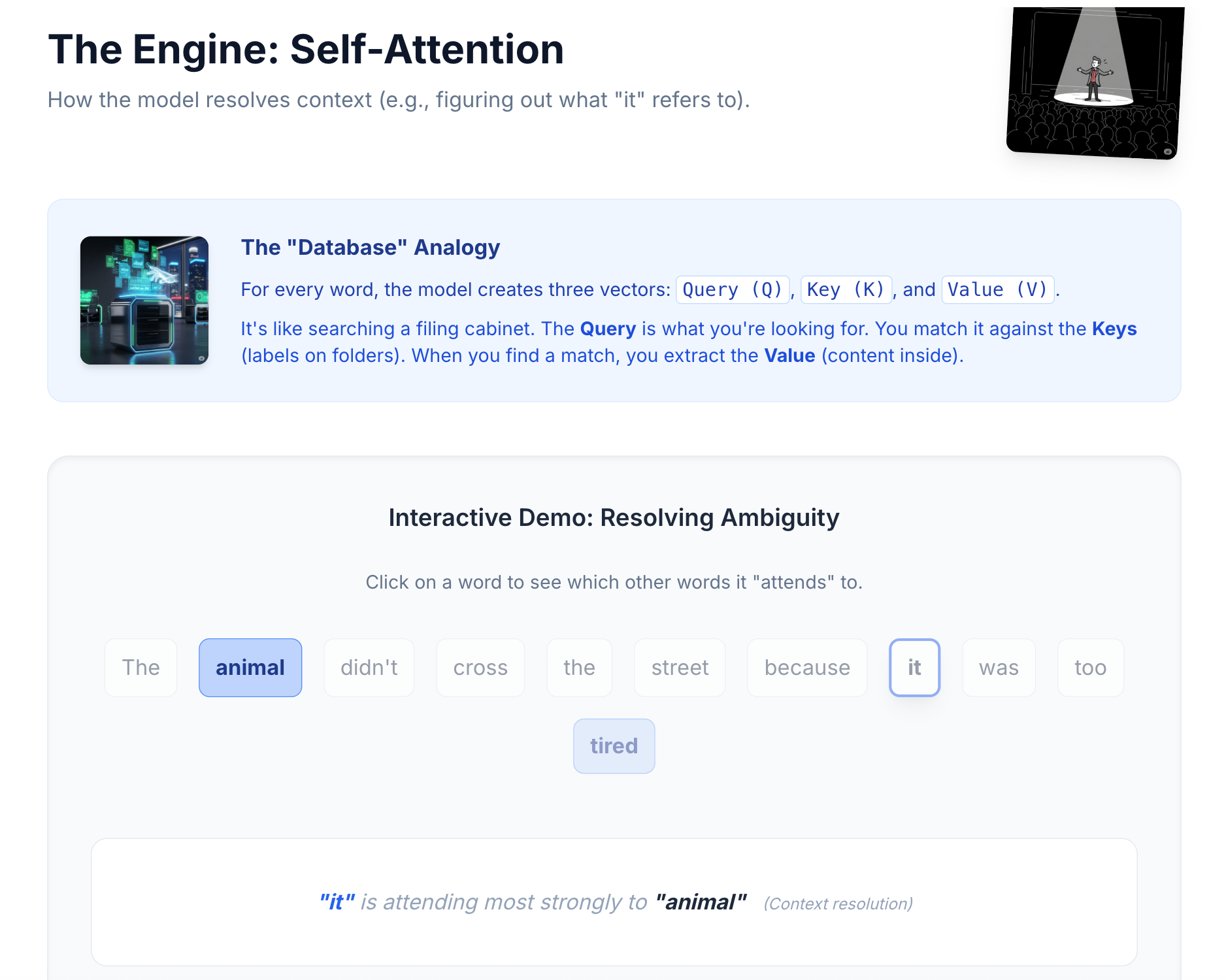
The “database” analogy (Query, Key, Value) translates a mathematically dense mechanism into an intuitive retrieval model, helping users grasp how contextual weighting operates without engaging with formal equations. The interactive ambiguity demo further strengthens this understanding. By clicking on a token such as “it”, users can see which other words receive higher attention weights. This makes context resolution—normally the result of abstract matrix operations—visually observable and conceptually clearer.
Finally, the translation demo adds a procedural layer to the explanation. Users can interactively observe how the model processes a simple input such as “Hello world”, moving through tokenisation, encoding, and autoregressive decoding step by step. Rather than merely stating that transformers generate output sequentially, the interface visually simulates the progression from input tokens to translated output (e.g. “Bonjour le monde”).
Recommendations
Gemini’s Dynamic View demonstrates clear pedagogical potential. For teaching, introductory overviews, or rapid conceptual orientation, the interactive format can significantly lower the entry barrier to technically complex material. Visual segmentation, clickable components, and step-by-step simulations make abstract architectures such as transformers more approachable, particularly for visually oriented learners.
However, the feature should be used with caution. Without a detailed or technically demanding prompt, the system tends to prioritise clarity and accessibility over formal depth. This can lead to conceptual simplifications that are helpful for overview purposes but insufficient for rigorous theoretical understanding. Researchers and advanced students should therefore treat Dynamic View as a visual scaffolding tool rather than a substitute for engaging directly with the original paper or mathematical formulation.
The author used Gemini 3 Pro [Google (2026) Gemini 3 Pro (accessed on 2 February 2026), Large language model (LLM), available at: https://gemini.google.com] to generate the output.