
Generative AI tools designed specifically for academic research are beginning to reshape how scholars conduct literature reviews and map scholarly debates. In this post, we test LeapSpace (ScienceDirect AI), Elsevier’s Scopus-integrated deep research assistant, to examine how it structures evidence, organises themes, and traces citation networks within peer-reviewed literature.
Introducing LeapSpace (ScienceDirect AI)
LeapSpace is Elsevier’s integrated research environment that brings together Scopus-indexed literature, full-text access on ScienceDirect, and generative AI support in one platform. At its core is ScienceDirect AI — a deep research assistant that operates over a curated academic corpus rather than the open web. This differentiates it from general-purpose language models: the outputs are traceable to peer-reviewed sources, citation counts, and indexed journals.
Rather than generating responses from broad internet data, LeapSpace’s AI retrieves and synthesises evidence directly from Scopus-indexed articles and ScienceDirect content. It can generate:
- structured literature overviews,
- thematic maps of a research field,
- ranked citation lists,
- narrative synthesis tied to specific academic sources,
- embedded references with DOIs and journal links.
LeapSpace also supports interactive features, such as Deep Research reports and clickable reference lists, which make it easier to navigate from summary to source within a single workflow.
Access and registration
LeapSpace and ScienceDirect AI are available to researchers through institutional subscriptions to Elsevier products. Users typically register or log in with their university or organisational credentials on ScienceDirect or Scopus. Some institutions provide direct LeapSpace access via their research portals. If your institution subscribes to Scopus/ScienceDirect, you can try LeapSpace via:
🔗 ScienceDirect AI overview
🔗 LeapSpace deep research environment
Once logged in with your institutional account, LeapSpace becomes accessible from the ScienceDirect/Scopus navigation menu.
Prompt
To test how LeapSpace structures an academic field, we began with a broad landscape query, see e.g.:
Provide an overview of the academic literature on legislative backsliding published in the last 10 years based on Scopus-indexed peer-reviewed journal articles. Identify key themes, leading authors, major journals, and publication trends.
Output
LeapSpace did not respond with a simple narrative paragraph. Instead, it first generated a thematic overview table, organising the literature into clusters such as conceptual debates, empirical case studies, methodological approaches, and regional trends. This table functioned as a research map rather than a summary.
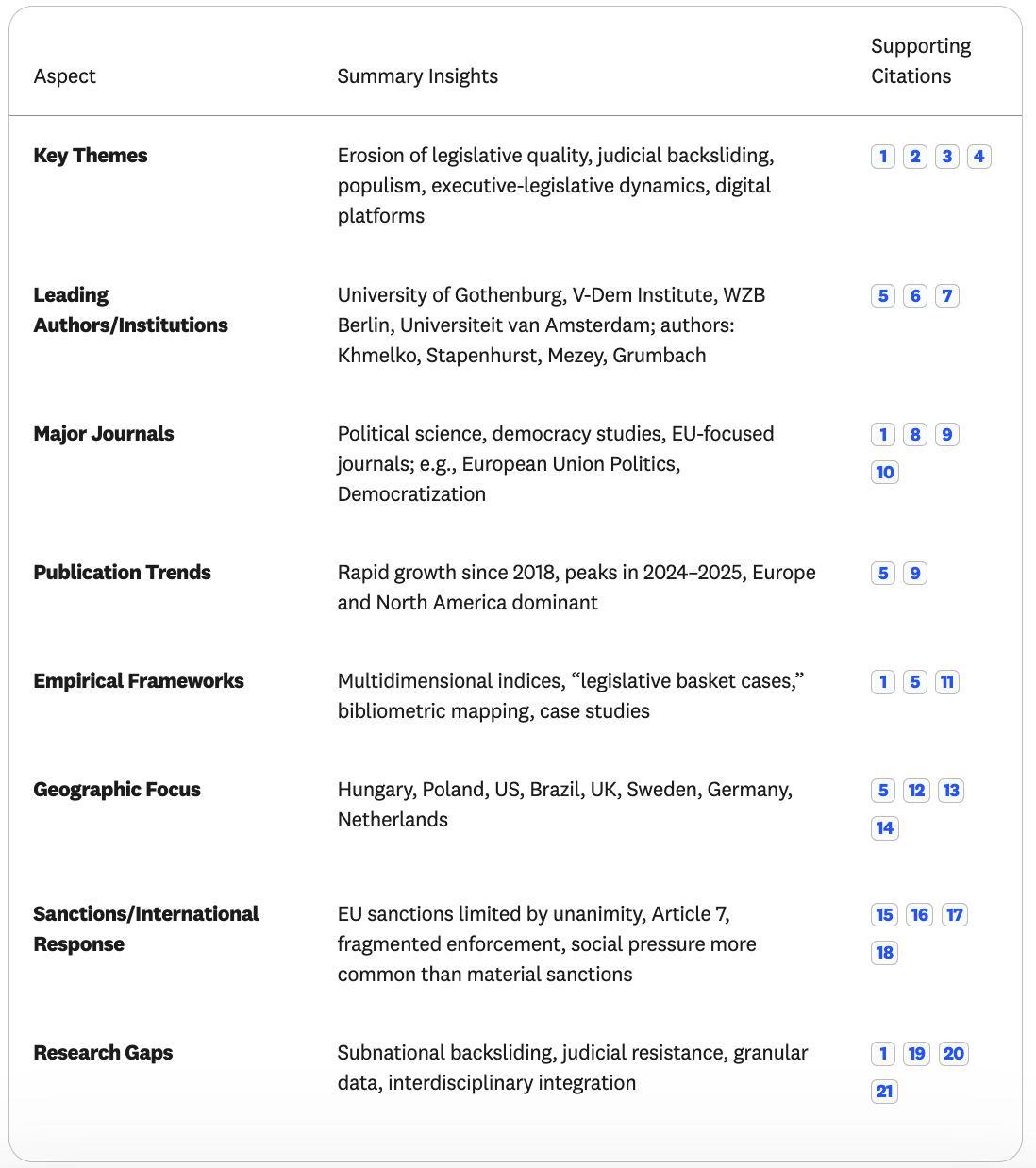
Only after presenting this structured breakdown did the system produce a narrative synthesis, explaining dominant strands of the literature and highlighting publication dynamics over the past decade. At the end of the response, all referenced articles appeared in a clickable list, each linking back to Scopus-indexed entries.
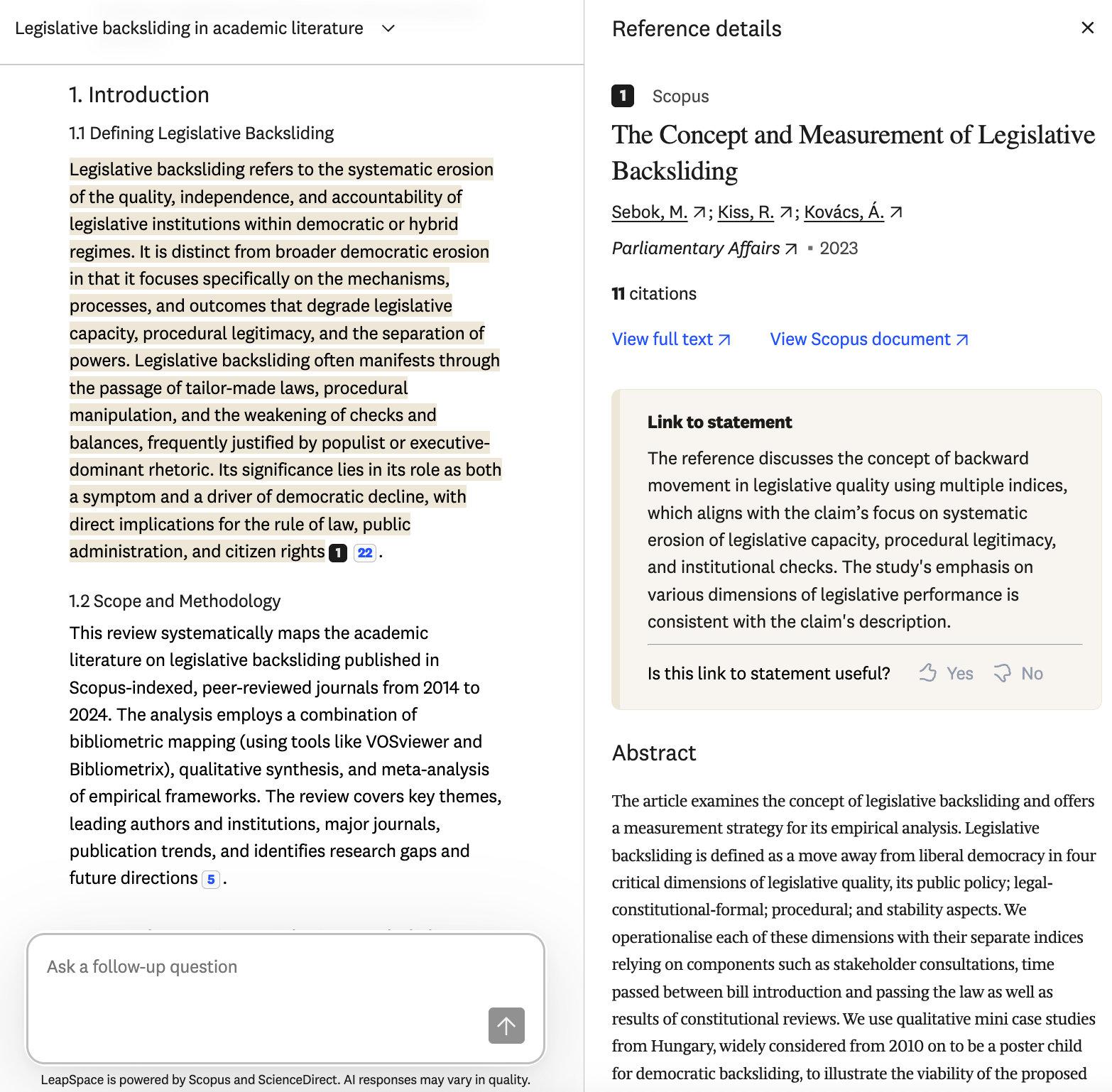
Importantly, the system remained strictly within the Scopus corpus. No grey literature, policy reports, SSRN working papers, or non-indexed law reviews appeared in the reference list. The output, therefore, reflects the boundaries of the indexed academic ecosystem rather than the broader intellectual debate.
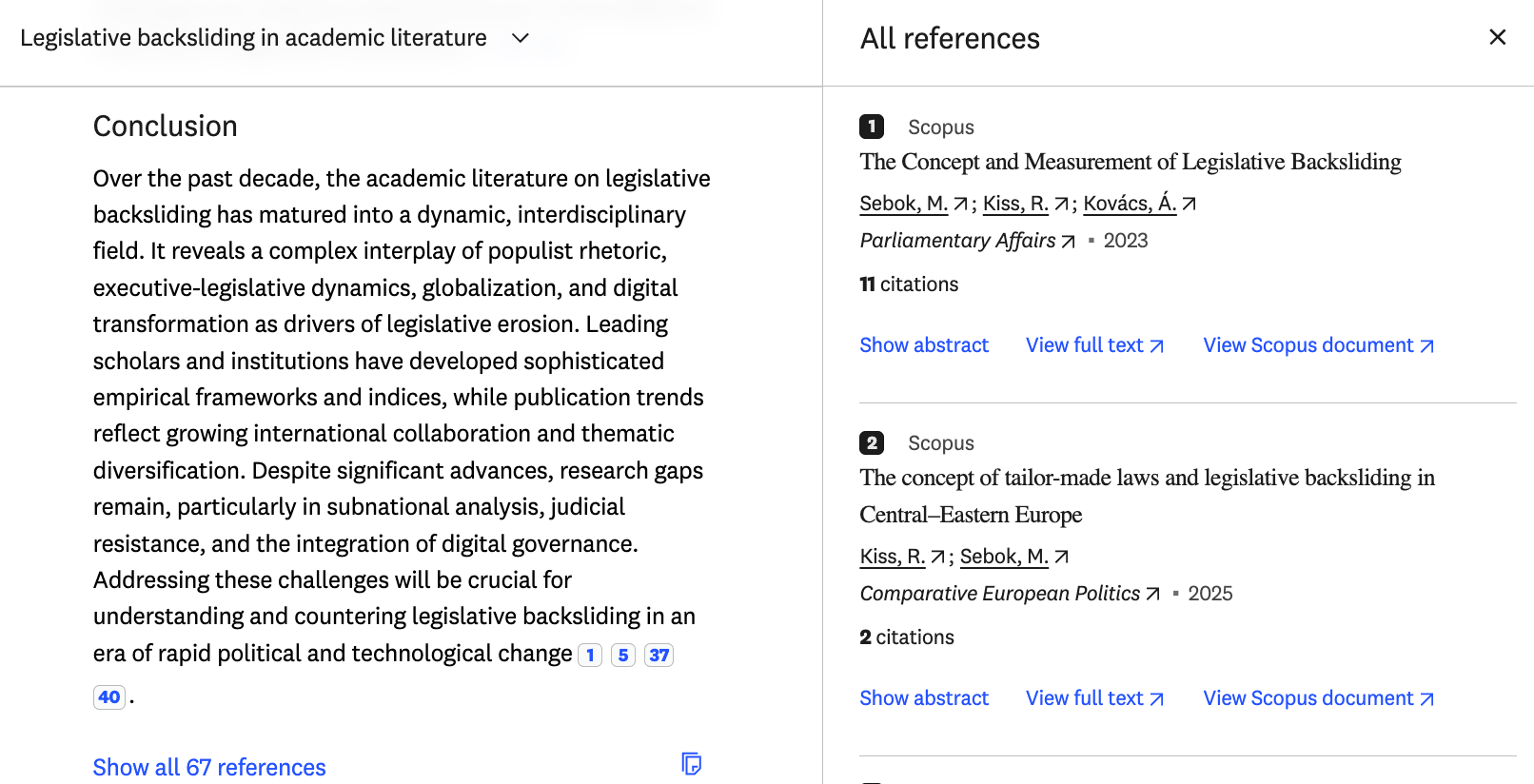
The literature used in the synthesis is accessible via the “All references” panel. By clicking on the numbered citations embedded in the summary, the user can immediately retrieve the full bibliographic details and navigate to the corresponding document.
As a next step, we moved from mapping the overall field to examining one specific article in more detail. The aim was to see how LeapSpace presents the relationship between a focal study and the later works that cite it.
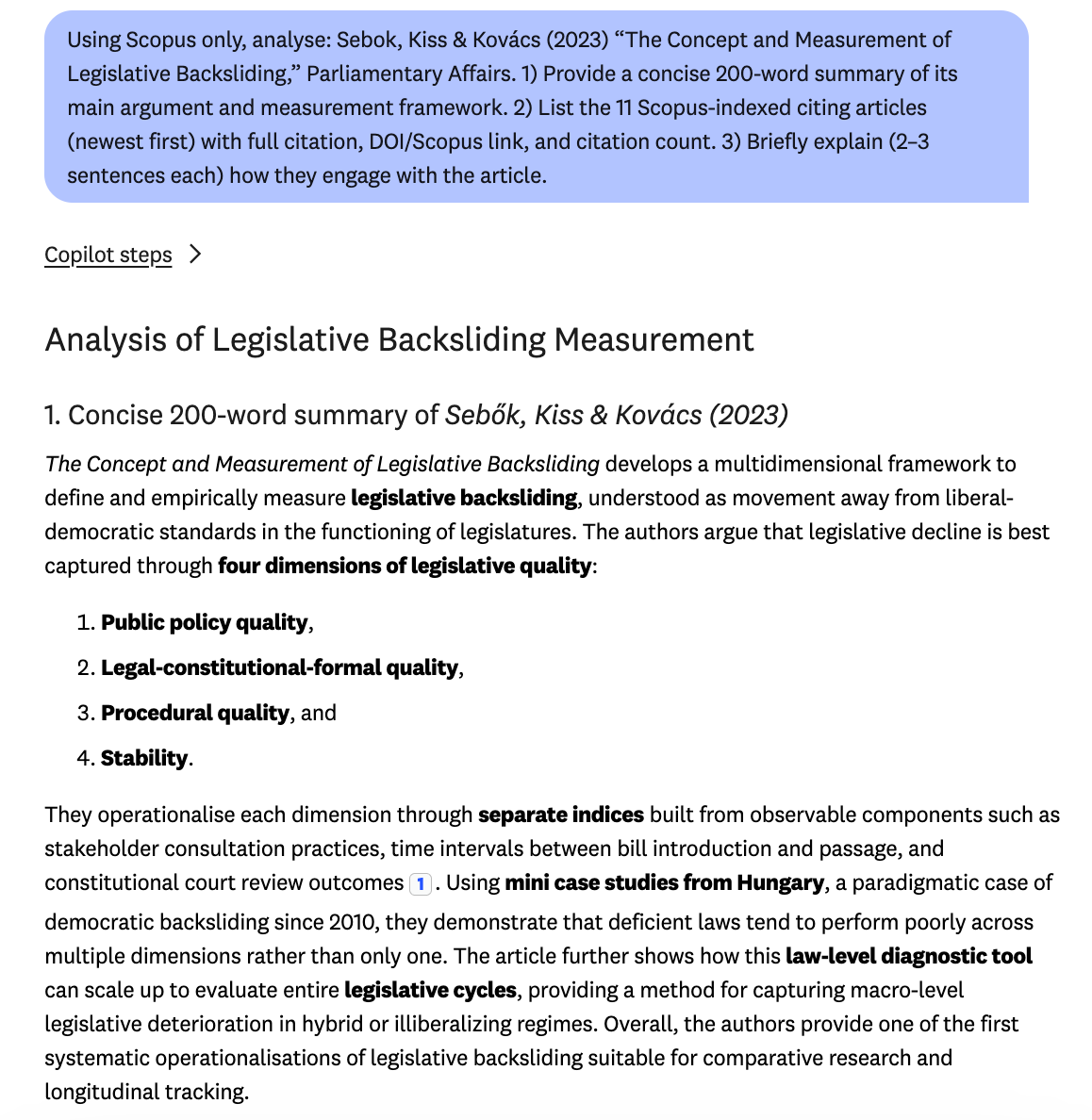
The system listed all 11 Scopus-indexed citing documents (newest first), and for each it briefly explained how the article engages with Sebők, Kiss & Kovács (2023)—whether by applying the measurement framework, extending it conceptually, or using it as contextual background.
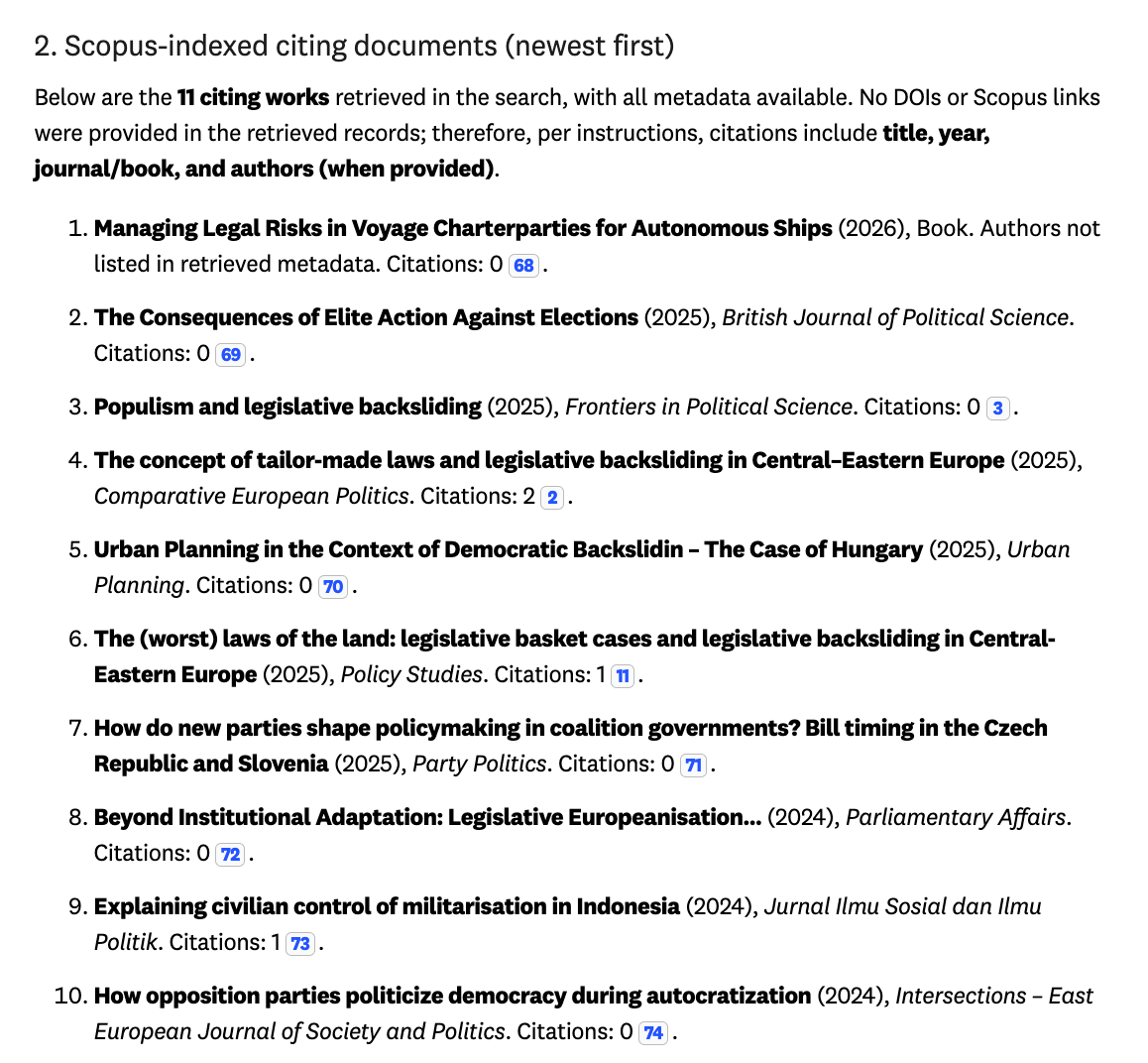
LeapSpace also provided a short synthetic overview of the overall pattern of engagement, highlighting how the 2023 framework travels across subfields and empirical contexts.
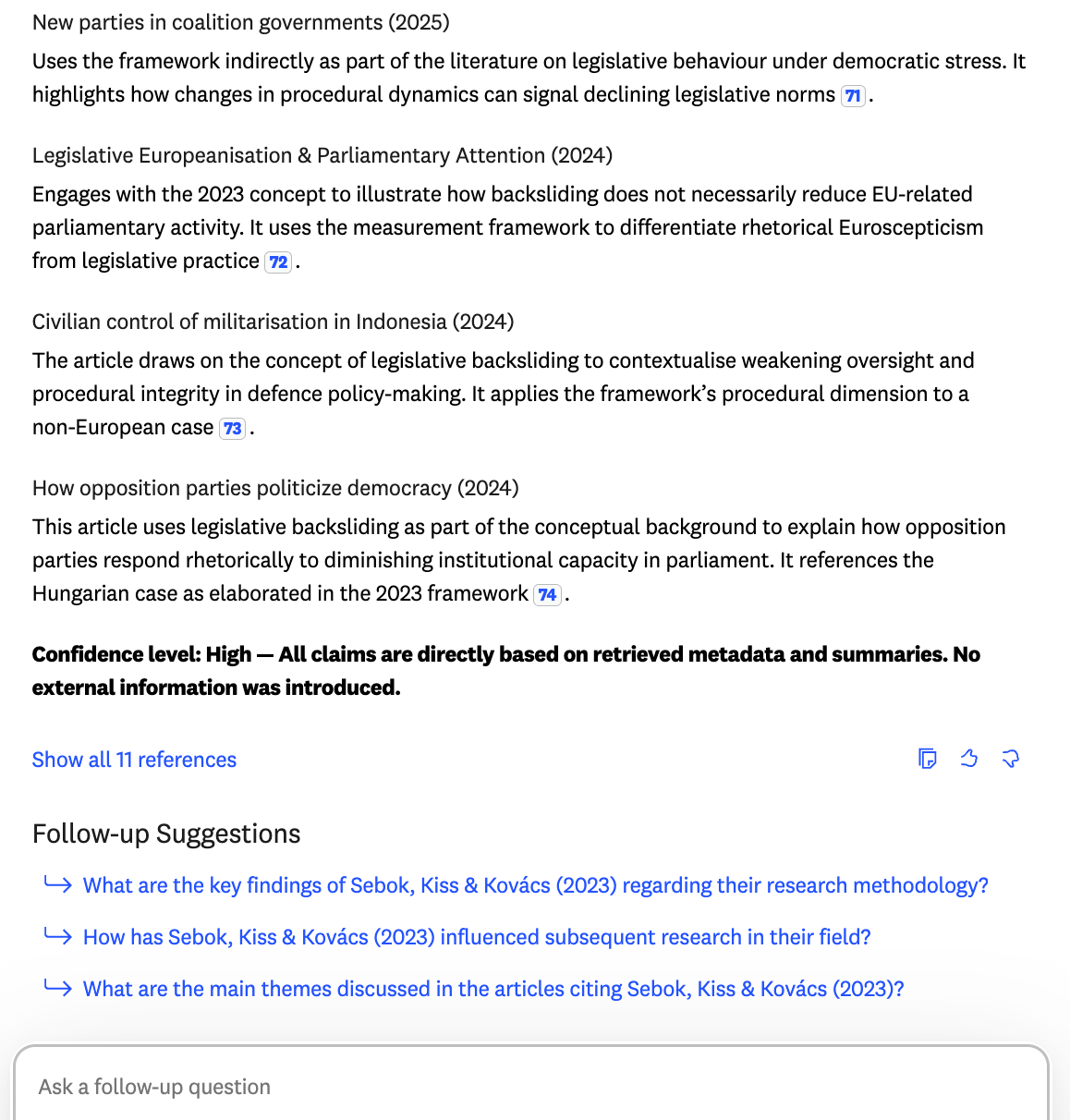
The displayed confidence level further signals that this remains AI-generated synthesis. While the output is strictly based on retrieved Scopus metadata and summaries, it may still contain inaccuracies or interpretative simplifications. Notably, the system explicitly acknowledges this limitation, thereby partially reflecting on its own epistemic boundaries.
Recommendation
LeapSpace is most valuable for structured, Scopus-based literature mapping, citation tracking, and field overviews. It is particularly useful for identifying themes, key authors, and citation networks within indexed academic journals. However, it reflects the limits of the Scopus corpus and produces AI-generated summaries that may contain inaccuracies. It should therefore be used as a research accelerator—supporting, not replacing, direct reading and scholarly verification.
The author used LeapSpace (ScienceDirect AI) [Elsevier (2026) LeapSpace (ScienceDirect AI) (accessed on 9 February 2026), AI-assisted research tool, available at: https://researcher.elsevier.com] to generate the output.